|
February 2026
Breastfeeding Family Friendly Communities
for a more breastfeeding, chestfeeding, & human milk feeding,
family-friendly community |
| |
Community Chronicle
February 2026 |
| |
|
Celebrating Black History Month
|
| |
|
Dear Friends of Breastfeeding Family Friendly Communities,
February has always carried both weight and possibility for me.
Growing up, Black History Month was one of the rare times each year when I felt invited to imagine something bigger—that people with curly hair and deeper brown skin could shape the world in meaningful ways. It opened a small but powerful window to dream, to envision new futures, even when representation felt limited in everyday life.
As we close out Black History Month, I find myself reflecting on how much that early sense of imagination still guides my work with Breastfeeding Family Friendly Communities. This mission is personal to me—and it is shared. If we want to create lasting change for families, it requires all of us working together across the communities we serve.
This winter has underscored just how connected and vulnerable we all are. When snow and ice forced us to cancel our events, it was a reminder that even our best-laid plans can shift. Many families are still navigating one of the most challenging winters we’ve had in years. In times like these, our commitments become clearer.
To me, Black history is not only something we honor—it’s something we actively live out. We are shaping history every day through care, through connection, and through our continued belief that every parent and every baby deserves to be supported.
As this month comes to a close, I invite you to keep learning and reflecting with us. Below is space to share resources that continue to inform and inspire this work:
Learning & Reflection Resources:
With deep gratitude and warm wishes,
Love Anderson
President & CEO
Breastfeeding Family Friendly Communities |
| |
|
Register Now:
BFFC Implementation Leaders Collaborative Round Table
|
| |
|
Join us this month at Breastfeeding Family Friendly Communities (BFFC) for a collaborative meeting with community leaders from across the country, all working to implement the BFFC designation in their respective cities and towns. This session is exclusively tailored for those spearheading the designation process, offering a platform to exchange ideas, learn from peers, and draw inspiration. With a focus on intimate and productive discussions, we anticipate a relatively small group, ensuring each leader gets ample opportunity to share and connect. This is also a perfect chance to liaise with the BFFC team for additional guidance and support.
Mar 25, 2026 02:00 PM
May 6, 2026 02:00 PM |
| |
|
Community Update:
BFFC Board Meetings
|
| |
|
Each board meeting will include short (5-minute) rotating updates from partner communities and projects.
Please send updates to newsletter@breastfeedingcommunities.org.
Updates can be:
- One image
- One Google Slide
- A short written update
Let us know if you'd like to join virtually when your update is shared.
If you'd like us to build a slide on your behalf (using a recent self-assessment, photo, or short update), just let us know.
Here are the BFFC Board Meeting dates for 2026. Meetings are held 4:00–5:30 PM ET on the fourth Monday of the following months:
- March 23
- April 27
- July 27
- August 24
- September 28
- October 26
|
| |
|
Identifying & Addressing Policy Gaps in Infant & Young Child Feeding
|
| |
|
BFFC highlights critical policy gaps that leave families without consistent, equitable infant and young child feeding (IYCF) support — and outlines how those gaps are being addressed through coordinated policy and systems change.
Key gaps and responses include:
- Infant & Young Child Feeding in Emergencies (IYCF-E): There is no federal requirement to integrate infant feeding into disaster preparedness and response. Check out the work of the SAFE team, which focuses on embedding IYCF into emergency plans, clarifying roles and responsibilities, and ensuring that supplies, trained personnel, and accountability structures are in place.
- Medicaid & Commercial Insurance Barriers: Insurance policies often restrict access to lactation care through reimbursement limitations, prior authorizations, and visit caps. Advocacy advances direct reimbursement for lactation providers and recognition of lactation care as preventive health services.
- Workplace Protections in Schools: School employees frequently lack protected lactation breaks and adequate space. A model school board policy addresses these gaps by institutionalizing protected time and appropriate facilities.
- Unequal Access to Lactation Care: Uninsured and underinsured families face limited access to care. The Breastfeed Durham Lactation Collaborative demonstrates a scalable public health model providing free and low-cost services.
- Administrative Barriers Across Benefit Systems: Gaps within Medicaid, WIC, and SNAP systems function as barriers to breastfeeding. Cross-system coordination and policy alignment aim to simplify access and protect continuity of benefits.
- Donor Human Milk Infrastructure: Limited pathways for safe donor milk distribution create gaps for medically vulnerable infants. Efforts strengthen systems to ensure access, including during emergencies.
- Clinical Accountability: Voluntary breastfeeding-friendly recognitions alone do not ensure consistent standards. Advancing accountability tied to licensure and reimbursement promotes evidence-based infant feeding practices.
- Long-Term Systems Planning: Durham County’s 10-Year Human Milk Feeding Strategic Plan embeds lactation and infant feeding into public health infrastructure, workforce development, data systems, and emergency response frameworks.
Together, these identified gaps — and the strategies addressing them — move infant feeding support from fragmented efforts toward coordinated, durable systems change. |
| |
|
Must-Reads: Insights That Matter
|
| |
- Discover how North Carolina’s community colleges became vital lifelines after Hurricane Helene and what lessons their response holds for future crises. Read here
- Learn more about Breastfeed Durham's outreach with pharmacies aligned with Step 8 of the Ten Steps to Breastfeeding Family Friendly Communities. Read here
- Explore how Breastfeeding Family Friendly Communities centers community voice when choosing inclusive language and why asking, listening, and adapting matters. Read here
- See how Breastfeeding Family Friendly Communities strengthens long-term local capacity through mentoring students, leveraging simple tools, and creating systems that last beyond staff and funding changes. Read here
- Check out concrete strategies from Breastfeeding Family Friendly Communities for getting started, like building partnerships, setting achievable goals, and using practical tools to take action. Read here
- Dive into how Breastfeeding Family Friendly Communities moves efforts from pilot projects to sustainable infrastructure, turning early wins into long-term, community-driven systems. Read here
|
| |
|
Recruitment Coordinator for Guilford County!
|
| |
|
The Recruitment Coordinator will play a vital role in expanding Guilford county’s Breastfeeding Friendly Community Partners initiative. The goal is to recruit historically underutilized businesses (HUBs) to become Breastfeeding Friendly Community Partners, creating a more inclusive and supportive environment for breastfeeding patrons and lactating employees. |
| |
|
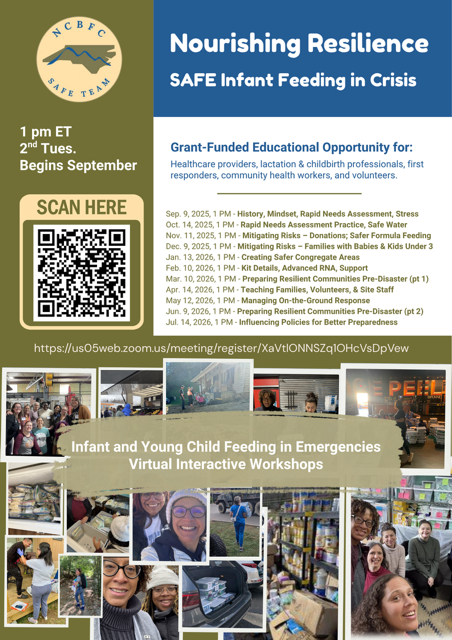
Nourishing Resilience: SAFE Infant Feeding in Crisis
|
| |
|
Resources for Winter Weather
|
| |
|
Our SAFE Infant Feeding team has created some winter weather resources and wanted to share them with you all.
- Planning Ahead for Winter Weather with Infants and Young Children
This 2-sided PDF explains the most important preparations for continuing to safely feed infants and young children in case of a loss of power or water.
- Winter Storm Prep for Babies (Images from social media) - English & Spanish
These files contain meme versions of most of the information in the "Planning Ahead" PDF. May also be shared directly from our social media channels, which are linked at the bottom of our contact page.
- Considerations for Those Supporting Families
This is a brief list of considerations for people supporting families with young children to think about in addition to the tips in the Planning Ahead handout.
|
| |
|
We want to highlight as many events, celebrations, and opportunities as possible for our community!
Please email fariha@breastfeedingcommunities.org if you have any upcoming events, celebrations, or opportunities you'd like us to share in our upcoming newsletters. |
| |
Updated CDC Early Childhood Nutrition Report 2025
The Centers for Disease Control and Prevention (CDC) released an updated version of the Early Childhood Nutrition Report, 2025. The update replaced data on four breastfeeding indicators among children born in 2021 with the newest available data from children born in 2022, from the National Immunization Survey-Child. The CDC's Nutrition Resources webpage includes both the 2025 Early Childhood Nutrition Report National Summary and State Reports.
NASEM Breastfeeding in the United States Report
The National Academies of Sciences, Engineering, and Medicine released the "Breastfeeding in the United States: Strategies to Support Families and Achieve National Goals" Consensus Study Report. The report provides a roadmap for helping families meet their breastfeeding goals and improving population-level outcomes. It emphasizes the need for strong federal coordination, comprehensive health care and community-based support, and inclusive public policies. Using a life course perspective, the report identifies key intervention points that begin before birth and continue through the return to work or school. Read the NASEM news release.
MAHA Strategy Report Includes Breastfeeding Commitments
The Make America Healthy Again Commission released the "Make Our Children Healthy Again" Strategy Report. The strategy document outlines a strategic approach for executive actions to address the childhood chronic disease crisis through advancing research, realigning incentives, increasing public awareness, and fostering private sector collaborations. The MAHA Strategy Report includes commitments to increase breastfeeding rates and to work with federal partners to promote and ensure a safe supply of donor human milk. As federal agencies refine implementation plans, the USBC will be monitoring closely to ensure that breastfeeding initiatives remain supported and adequately funded.
Report on Closing the Black Maternal-Health Gap
The McKinsey Institute for Economic Mobility released a report, "Closing the Black maternal-health gap: Healthier lives, stronger economies." The report examines urgent and preventable disparities in Black maternal health, which, if reduced, would strengthen families, improve community health, and contribute meaningfully to the nation’s economic vitality. |
| |
|
Breastfeeding Friendly Designation |
| |
|
Breastfeeding Family Friendly Communities is a community-wide program to impact Health Equity by advocating for policies and practices that support optimal infant feeding. Any municipality or incorporated region may complete the Ten Steps self-appraisal. Work begins when two or more community members come together to lead the community in satisfying the requirements of the Ten Steps to a Breastfeeding Family Friendly Community.
Is your community interested in beginning the designation process to becoming a Breastfeeding Family Friendly Community? Contact us for resources to help your community get started on the journey. Take the first step and fill out our interest form. |
| |
|
Using the Ten Steps to a Breastfeeding Family Friendly Community (Ten Steps), we will provide education, mentorship, and assistance to communities as they work to make changes so that every family that is chest/breastfeeding will be able to do so in a space that is welcoming and supportive of their efforts. With your donation, these communities are able to engage with local businesses, child care centers, and health care providers to support breast/chestfeeding families.
|
| |
|