
On this page: November proclamations · September 2026 update · Child care survey · Guilford County breastfeeding resources · Breastfeeding-friendly businesses · Self-appraisal of the Ten Steps
Join us: breastfeeding proclamations this November
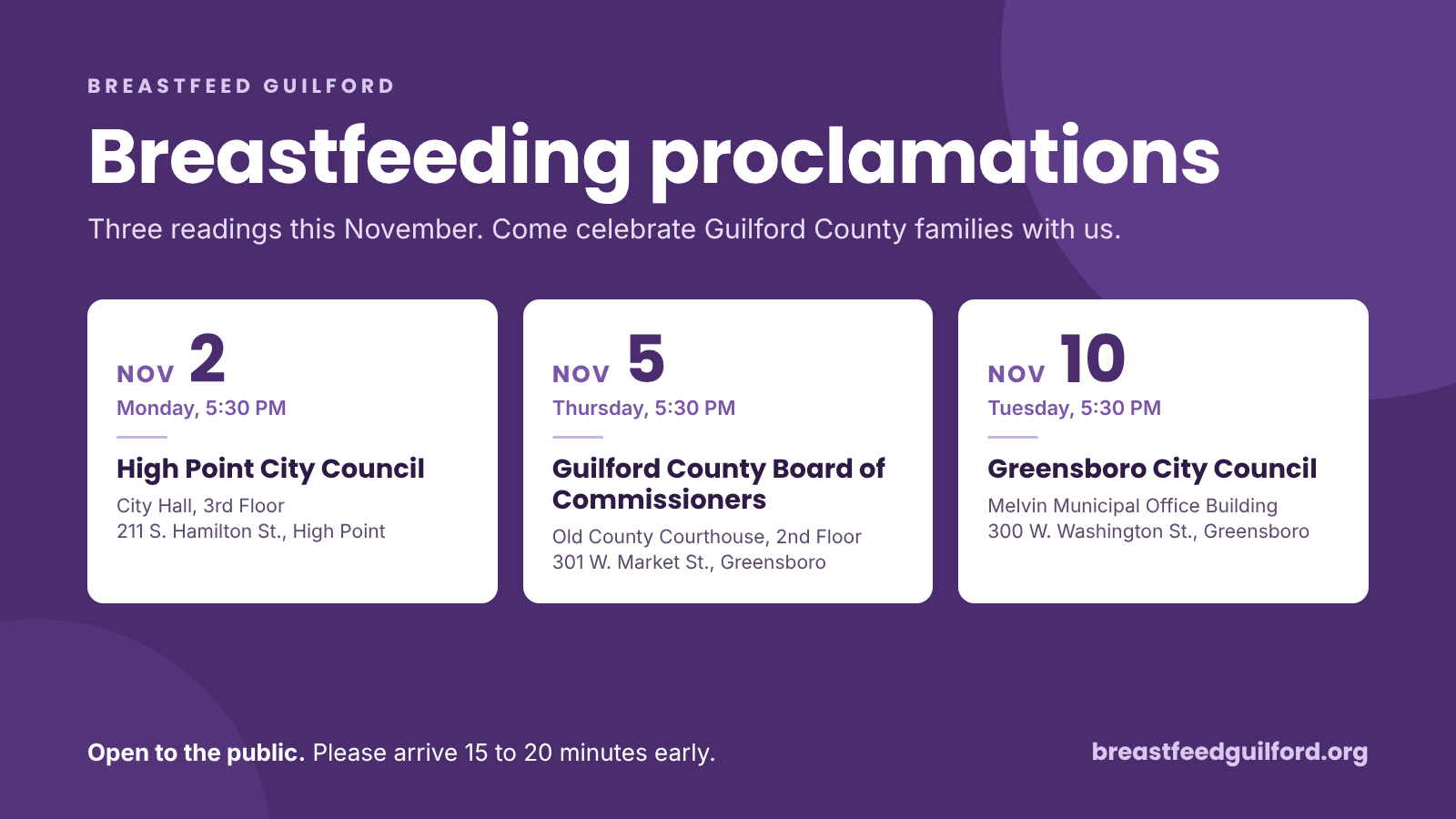
This November, three local governments will each present a breastfeeding proclamation, recognizing the families, child care providers, and partners working to make Guilford County a place where breastfeeding families feel supported and welcome. These meetings are open to the public, and we would love to see you there. Plan to arrive 15 to 20 minutes early.
- High Point City Council: Monday, November 2, 5:30 PM. City Hall Council Chambers, 3rd Floor, 211 S. Hamilton Street, High Point. Free parking in the lots outside the building and along S. Hamilton Street. Can’t make it? Watch live on Channel 8 or the High Point CivicClerk Portal. Read the High Point proclamation (PDF)
- Guilford County Board of Commissioners: Thursday, November 5, 5:30 PM. Commissioners’ Meeting Room, 2nd Floor, Old County Courthouse, 301 W. Market Street, Greensboro.
- Greensboro City Council: Tuesday, November 10, 5:30 PM. Katie Dorsett Council Chamber, Melvin Municipal Office Building (City Hall), Plaza Level, 300 W. Washington Street, Greensboro.
Where things stand: September 2026 update
Breastfeeding Family Friendly Communities (BFFC) received seed funding from the Guilford County Department of Public Health to launch this initiative, and in fall 2025 we began implementing the Ten Steps to a Breastfeeding Family Friendly Community in Guilford County. We are grateful for that start and for every partner who helped build the foundation described in the appraisal below.
That support concluded on June 30, 2026, at the close of the county fiscal year. The work has continued without interruption. On November 1, 2025, BFFC secured funding from the Heritage Home Foundation, and the Guilford County Partnership for Children has committed support toward Breastfeeding Friendly bundles for child care programs. Over the past year we hired community health workers in Guilford County, and they have been a real gift to this work. We have secured funding for them to continue at five hours a week through November 1, 2026, and bundle deliveries to child care programs begin in mid September.
A core group of the BFFC Guilford County team met through the summer, and in August the team attended the mixer at the Uplifting Black and Brown Lactation Success Conference, hosted by the North Carolina Breastfeeding Coalition and sponsored by BFFC. On September 30, BFFC will host a virtual gathering of the Breastfeeding Family Friendly Communities of Guilford County implementation team. This is the broader group of partners who came together through the Breastfeeding Collaborative mixers and informational sessions, and it has grown into a collective action movement. The implementation team will meet every two weeks through November 1. A public health graduate student from Temple University is supporting the team and will continue reaching out to implementation team members through the school year, encouraging them to carry out the commitments they made during our needs assessment.
BFFC has always been a volunteer-driven organization. Volunteers move with or without funding, and we expect this coalition to keep moving. Let’s see this movement move.
Child care providers: take the breastfeeding-friendly child care survey
Child care programs shape how the youngest children in Guilford County see feeding, and they are often the first place a family has to make expressed milk work outside the home. BFFC is inviting every licensed child care program in Guilford County to complete a short survey about how your program supports breastfeeding families and what would help.

Programs that complete the survey receive a free Breastfeeding Friendly bundle, delivered by our community health workers starting in mid September: children’s books that show breastfeeding as normal, a plush nursing cat for the reading corner, a poster for your space, and a one-page guide to lactation support in Guilford County. Bundles are funded by the Heritage Home Foundation and the Guilford County Partnership for Children.
Guilford County breastfeeding resources
One page, ready to print or share: where to find lactation support, WIC, support groups, and help in Guilford County.
Breastfeeding-friendly businesses and organizations in Guilford County
The North Carolina Breastfeeding Coalition recognizes businesses and organizations that welcome breastfeeding families with its Community Partner Award, supports lactating employees with its Employer Award, and recognizes clinics with its Family Friendly Clinic Award. These Guilford County businesses and organizations have earned that recognition.
Greensboro
- Agape Love CCD (Employer and Community Partner, 2026)
- City of Greensboro (Employer and Community Partner, 2017)
- Crafted, The Art of the Taco (Community Partner, 2026)
- Deep Roots Market (Community Partner, 2013)
- Friendly Avenue Christian Preschool (Employer and Community Partner, 2019)
- Goodwill Industries of Central North Carolina (Employer and Community Partner, 2017)
- Greensboro College (Employer and Community Partner, 2026)
- Greensboro Montessori School (Employer and Community Partner, 2018)
- Greensboro Public Library, Benjamin Branch (Community Partner, 2026)
- Guilford County Partnership for Children (Employer and Community Partner, 2017)
- Hair Designs by Dee (Employer and Community Partner, 2010)
- Jerusalem Market on Elm (Community Partner, 2026)
- Junior League of Greensboro (Employer and Community Partner, 2018)
- Little Brother Brewing (Community Partner, 2026)
- Little Leaders Learning Academy (Employer and Community Partner, 2021)
- Magnolia Birth Center (Family Friendly Clinic Award, Closed)
- North Carolina A&T State University (Employer and Community Partner, 2018)
- Partners Ending Homelessness (Employer, Closed)
- Scuppernong Books (Community Partner, 2026)
- Sticks and Stones Clay Oven Pizza (Community Partner, 2013)
- Teach For America (Community Partner, 2018)
- Ultimate Fertility Consulting (Community Partner, 2025)
- United Way of Greater Greensboro (Employer and Community Partner, 2016)
- University of North Carolina at Greensboro (Employer and Community Partner, 2020)
- The Volunteer Center of Greensboro (Employer and Community Partner, Closed)
- Women’s Hospital, Cone Health (Employer and Community Partner, 2013)
High Point
- Births Your Way (Community Partner, 2013)
- Cornerstone Pediatrics at Premiere (Family Friendly Clinic Award, 2016)
- High Point Chiropractic (Employer and Community Partner, 2018)
- High Point Regional UNC Health Care, now High Point Medical Center (Employer and Community Partner, 2014)
- Novant Health Pediatrics, Oak Hollow (Family Friendly Clinic Award, 2019)
Countywide
- Guilford County Division of Public Health (Employer and Community Partner, 2017)
Is your business breastfeeding friendly? Apply for recognition through the North Carolina Breastfeeding Coalition, and we will add you here.
Guilford County self-appraisal of the Ten Steps
Assessment performed fall of 2025.
A note on this appraisal: every step, measure, and service described below operates on a universal access model. Every service is open to all families, and none is denied to anyone on the basis of race, color, ethnicity, national origin, immigration status, religion or creed, age, sex, pregnancy or lactation status, sexual orientation, gender identity, family structure, primary language, ability or disability, veteran or military status, or socio-economic status.
Step 1: Leadership Support for Breastfeeding (In Progress)
Celebration:
Guilford County is showing strong leadership by embedding breastfeeding work into the county-wide strategic planning process and aligning it with the Infant Mortality Task Force. The fact that breastfeeding is being integrated into broader maternal and child health policy conversations is a huge win. This approach ensures breastfeeding is not siloed but addressed as part of the county’s broader health strategy. They are also actively engaging their Breastfeeding Coalition and Breastfeed Guilford as key partners, which grounds the work in both professional and community voices.
Measures:
- Your community has a signed proclamation and/or policies that include action steps to support all the steps to becoming a Breastfeeding Family Friendly Community. Proclaim every 3 years. (1i)
- Your community routinely shares the signed proclamation/policies via social media and other local media outlets.
- Your community ensures that local media outlets host an annual discussion with breastfeeding experts on this issue.
- Your community distributes a copy of the Ten Steps designation and the local policy/proclamation at least annually, ideally during World Breastfeeding Week or National Breastfeeding Month.
Step 2: Welcoming Atmosphere for Breastfeeding Families (In Progress)
Celebration:
Guilford County leaders are thinking expansively about making their communities visibly breastfeeding-friendly. Acknowledging the complexity of working with multiple municipal park systems, they wisely identified libraries as a first focus area. Libraries reach families across socioeconomic lines, are trusted community institutions, and can be early adopters of signage and staff training. At the same time, they are also exploring broader signage opportunities in parks, downtown spaces, airports, and sports facilities, recognizing the need for families to feel welcome wherever they go.
What They’re Already Doing:
- Identified community partners for signage initiatives: Guilford County Parks, Greensboro City Parks, High Point City Parks, Private downtown parks (LeBauer Park and Center City Park, both nonprofit-managed)
- Focusing this year’s work on libraries as a pilot site for signage and staff training.
- Considering future expansion to: Sports fields and youth recreation sites, airport facilities, downtown Greensboro and High Point, other highly visible public spaces, elementary schools, daycare facilities, and YMCAs
The first responder training built with Breastfeed Guilford is available to any community: First Responder Training.
Measures:
- Your community has posted breastfeeding “Welcome” signage next to the community’s welcome signs or in other prominent locations.
- Your community displays a breastfeeding “Welcome” seal/logo on community websites and/or social media, or makes flyers available at visitor centers.
- Your community enforces federal or state laws that support public breastfeeding.(e.g., North Carolina law states that mothers have the right to breastfeed anywhere they are legally allowed to be)
Step 3: Support from Health Leadership (In Progress)
Celebration:
Healthcare partners in Guilford are stepping forward in meaningful ways. Cone Health has launched a breastfeeding initiative aimed at reducing infant mortality, hired IBCLCs at Cone Health Center for Women’s Healthcare, and begun a Quality Improvement project focused on reducing unnecessary formula use by better educating both families and providers. This is a major strength to build on. At the same time, High Point Medical Center (part of Advocate Health / Atrium Health Wake Forest Baptist) has hired an IBCLC and OB Navigator, who are both working to establish resources and support for lactating families in the Greater High Point area.
What They’re Already Doing:
Cone Health:
- Updating infant feeding policies to align with the WHO definition of optimal infant feeding.
- Actively recruiting and integrating IBCLC staff into care teams.
- Implementing a quality improvement project to identify barriers to lactogenesis and address prevalent misinformation.
High Point Medical Center (part of Advocate Health / Atrium Health Wake Forest Baptist):
- On the journey to align with NC Maternity Center Breastfeeding–Friendly Designation Program. They have completed multiple steps and plan to apply for star rating in 2026.
- Recently hired an IBCLC and engaging with community collaboratives.
- Identifying gaps and needs of services in the Greater High Point area to determine programming and support for lactating families.
WIC & Public Health:
- Providing direct family support through education, classes, and counseling services.
- Currently implementing breastfeeding-friendly policies.
Measures:
- The Designating Team or your local Breastfeeding Coalition identifies the health leaders in your community, such as the local health department director, WIC office director, hospital board members, or head nurse at the local hospital. (3i)
- The defined health leaders have confirmed and approved the World Health Organization’s definition of optimal infant feeding, or an equivalent, and this definition has been disseminated to healthcare providers and community leaders.
Step 4: Information During Pregnancy (In Progress)
Celebration:
Cone Health is preparing branded prenatal materials for OB practices and is considering how these can be adapted for wider county-wide use. Community partners are eager for shared, non-commercial, culturally relevant resources to create consistent messaging across WIC, hospitals, home visiting programs, and community-based organizations. Guilford’s infrastructure, including Breastfeed Guilford, Healthy Steps specialists, and home visiting programs, creates an excellent foundation for distributing these resources and reinforcing breastfeeding education early in pregnancy.
What They’re Already Doing:
- Cone Health developing prenatal education materials for OB practices, MedCenter for Women, and potentially broader distribution.
- Strong home visiting program and community navigation infrastructure already in place.
- Interest in shared, evidence-based, multilingual messaging (English, Spanish, Haitian Creole, French).
- Ongoing QI project at Cone Health to analyze what pushes families to formula use.
Measures:
- Healthcare systems in your community distribute non-commercial materials about the benefits of breastfeeding and the risks of unnecessary formula use to faith-based and community organizations (4i)
- Community-based organizations distribute non-commercial materials about the benefits of breastfeeding and the risks of unnecessary formula use.
- Distributed materials are culturally appropriate and reflective of the population served.
- Distributed materials include information on where to access breastfeeding support as needed.
Step 5: Breastfeeding-Friendly Healthcare (Planning)
Celebration:
Cornerstone Pediatrics in High Point has NC Family Friendly Clinic Award.
What They’re Already Doing:
- Cone Health used to have Baby-Friendly Hospital designation but this was dropped by executive leadership.
- Atrium Health Wake Forest Baptist hospitals, including High Point Medical Center, are actively working toward the NC Maternity Center Breastfeeding-Friendly Designation Program, which aligns with many of the Ten Steps.
Measures:
- All maternity care centers in your community are designated Baby-Friendly or hold an equivalent state-level designation that supports breastfeeding. (5i)
- At least 50% of prenatal and postnatal outpatient care clinics in your community have applied for or documented breastfeeding-friendly support and training.
Step 6 Availability of Lactation Support (In Progress)
Celebration:
The Breastfeed Guilford website will offer visitors a comprehensive lactation support directory.
What They’re Already Doing:
- Guilford has completed a comprehensive lactation support directory and plans to publish it on the Breastfeed Guilford website.
Measures:
- Your community has established or confirmed the availability of active breastfeeding support groups.(6i)
- Your community has established or confirmed the availability of Lactation Consultants: International Board Certified Lactation Consultants (IBCLCs) and other skilled lactation support services.
- Make a comprehensive resource list of the lactation support (support groups, IBCLCs, classes, etc) in your community.
- Special attention is given to ensuring that lactation support services meet the needs of marginalized and underserved communities.
- At least one in-person or virtual meeting has been held annually to coordinate breastfeeding support efforts in your community.
- Your community has communicated information about available lactation support services to the public at least once annually.
Step 7: Welcoming Businesses and Organizations (In Progress)
Celebration:
Calculated how many businesses in Guilford County would be required to meet this requirement. The estimated resident population of Guilford County, North Carolina is 558,816 (as of July 1, 2024). So there is roughly one business per 500 residents = about 1,118 total businesses needed to reach that benchmark in Guilford County.
What They’re Already Doing:
- 26 Businesses have completed a form to support the Making It Work program on the Breastfeed Guilford website
- Planned pilot for launching Community Choice recognition and feature winners on the Breastfeed Guilford website.
Measures:
- Your community has calculated the number of businesses needed to meet the Breastfeeding Family Friendly Community requirement: 1,118
- At least one business for every 500 people in your community has signed a form stating they welcome breastfeeding in their place of business.
- These businesses display welcome signs or a “Breastfeeding Welcome” logo.
Step 8: Adherence to the Code of Marketing (Planning)
Measures:
- Healthcare facilities in your community provide breastfeeding education and support to parents without promoting commercial infant formula through ads or free samples.(8i)
- Locally-controlled grocery stores in your community do not promote commercial infant or related toddler formula through preferential shelf placement or ads.
- Locally-controlled food markets and convenience stores in your community do not promote commercial infant or related toddler formula through preferential shelf placement or ads.
- Locally-controlled pharmacies in your community do not promote commercial infant or related toddler formula through preferential shelf placement or ads.
- Non-locally controlled grocery stores, food markets, convenience stores, and pharmacies in your community are encouraged to display lactation support information near infant formula/foods and to prevent local advertising of formula.
Step 9: Workplace Accommodation for Lactating Employees
Measures:
- The current state of the laws concerning mandated business support for breastfeeding is made available to all Chamber of Commerce members, similar business groups, and other businesses (e.g., U.S. Dept. of labor materials provided by local breastfeeding organization or health department) annually.(9i)
- The Chamber of Commerce, or a similar organization, disseminates the US Business Case for Breastfeeding, WABA maternity care, or equivalent materials annually.
Step 10: Education Systems Include Breastfeeding in Curriculum (Planning)
Measures:
- The local School District or Department of Education provides books and/or images that illustrate breastfeeding as the norm.(10i)
- Breastfeeding-friendly curricula are introduced at all levels of education.
- Your community’s preschools and early education centers include breastfeeding-friendly curricula in their programs.
- Your public school system has introduced breastfeeding-friendly curricula at all educational levels.
- Universities in your community include breastfeeding-friendly curricula in relevant courses or programs.