One of our SAFE Infant Feeding Team research partners has a new paper out, and it puts careful evidence behind something we say all the time: when we talk about feeding babies in a crisis, we have to talk about water.
Disparity data explains where to expand access; it is never an eligibility screen. Every program described here is open to all families.
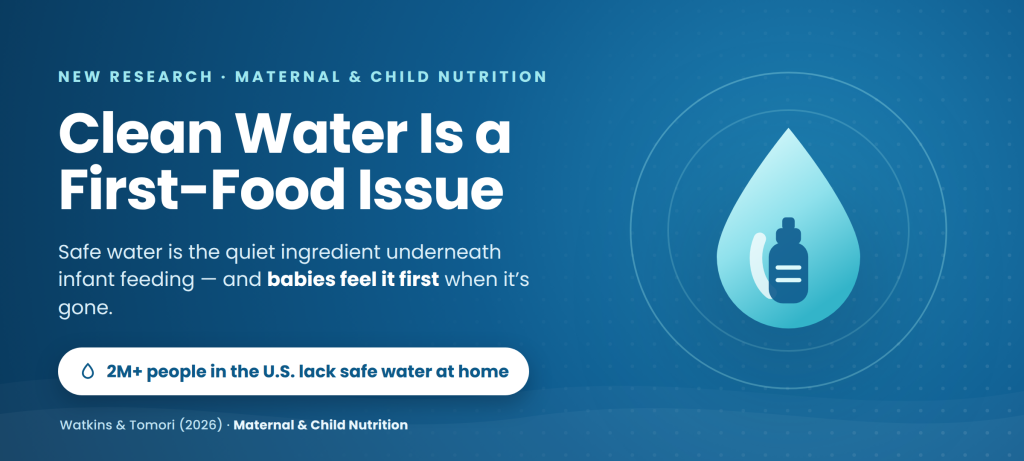
Dr. Cecília Tomori of the Johns Hopkins Bloomberg School of Public Health, who helps ground the SAFE Team’s work in equity and the structural realities families actually face, co-authored a policy analysis this spring in Maternal & Child Nutrition with Cristina Watkins. It lays out a connection that’s easy to miss until a disaster makes it impossible to ignore: clean, safe water is the quiet ingredient underneath every way we feed an infant, and when it disappears, babies are the first to feel it.
The scale is sobering, and it reaches every part of the country. More than two million people in the United States don’t have safe drinking water at home, and climate change keeps making that harder to hold steady through stronger storms, flooding, drought, and aging infrastructure. From the coasts to the heartland, the families carrying the heaviest load are disproportionately Black, Indigenous, and other communities of color.
Here’s why this lands squarely on infant feeding. A family that depends on formula needs safe water to mix it and to clean bottles and feeding equipment. When the water isn’t safe, or isn’t there at all, that becomes an emergency in hours, not days. Breastfeeding offers real protection in exactly these moments, because it doesn’t depend on a clean water supply. But the paper is candid about something we hold to: breastfeeding isn’t simply a personal choice a parent makes alone. It needs structural support to be possible, especially for families already stretched thin.
The hopeful part is that workable solutions already exist. The paper points to WIC, the Special Supplemental Nutrition Program for Women, Infants, and Children, which reaches roughly 41% of all U.S. infants in communities everywhere. As a program with that kind of reach, it’s well positioned to screen for water insecurity, connect families to testing and filters, and strengthen breastfeeding support, no matter where a family lives. These are practical, fundable steps, not someday-ideas.
This is the heart of what we believe at Breastfeeding Family Friendly Communities: protecting how babies are fed is community resilience work, and it belongs in the same conversation as water, climate, and emergency planning, not off to the side as a “lactation issue.” We’re based in North Carolina, but this is true for families in every state, and our readers and partners are working on it across the country.
Our SAFE Team, the disaster-response project we co-founded, goes deeper on what this paper means for emergency planners and public health teams, and what to ask for wherever you live. Read that piece here.
The full article is open access and worth your time:
Watkins, C., & Tomori, C. (2026). Addressing the Impacts of Water Insecurity on Infant Feeding: Policy Solutions for the US. Maternal & Child Nutrition, 22(3), e70205. https://doi.org/10.1111/mcn.70205
In love and gratitude,
Breastfeeding Family Friendly Communities