The U.S. Breastfeeding Committee fully released its national plan, Nourishing, Thriving Communities: A National Plan for First Foods, Breastfeeding, and Lactation Support through Policy, Systems, and Environmental Change. I’ve had it open on my desk alongside three other documents that shape the ground we all stand on: the 2025 National Academies report, Breastfeeding in the United States; NACCHO’s Continuity of Care in Breastfeeding Support: A Blueprint for Communities; and our own Ten Steps to a Breastfeeding Family Friendly Community.
People keep asking me how they fit together. They’re threads in one cloth, and the thing that finally made the whole tapestry make sense to me is that each one answers the same three questions: Who is my audience? What can I do with my power? What does my capacity look like?, for a different set of hands.
Let me start with the plan, because it deserves the first and the longest word.
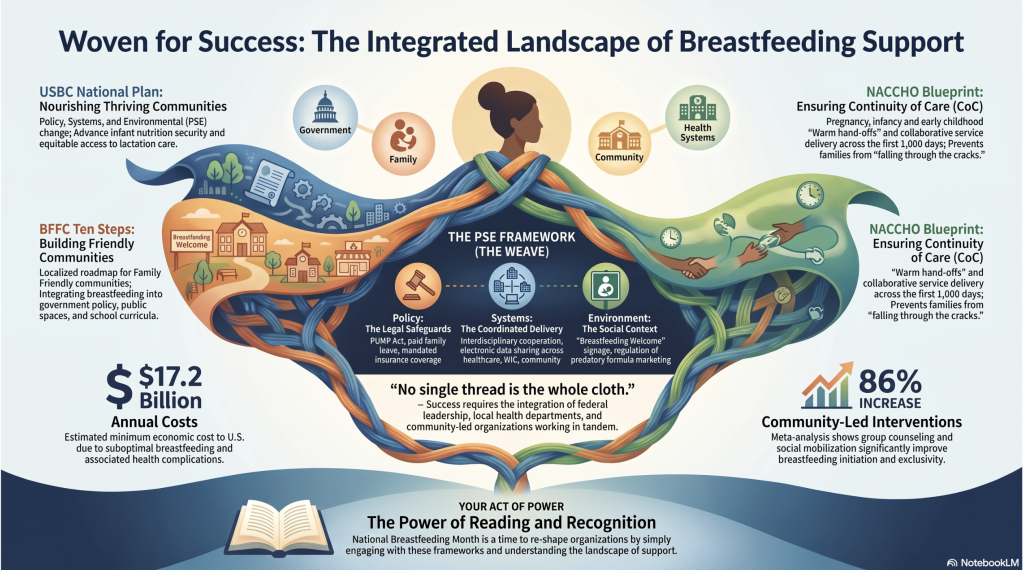
The national plan holds the whole cloth. I spent months of my life as a member of its Advisory Council, and I want to be clear-eyed about what it accomplished, not just proud of it. It is big and it is small at the same time. It reaches all the way up to federal policy: amending the WIC statute, requiring Medicaid and insurers to reimburse pasteurized donor human milk, building national safety guidance, and it reaches all the way down to concrete actions a single clinic, employer, or coalition can take next month. It gives health systems a role, and employers, and public health, and researchers, and community organizations, and policymakers. When it says we all share responsibility, it means it, and it backs it up with something specific for each of us to do.
And it contains pieces I find genuinely moving. Its human milk work refuses to treat community milk sharing as marginal or exceptional. It names donor human milk, formal milk banking, and community-based exchange models as parts of one shared infrastructure, honoring that families and communities have quietly shared human milk for generations, especially where formal systems were unavailable or never built with them in mind. It even defines community self-determination in its own key terms, and deliberately sets it apart from mere “community engagement”: the ability of communities to define their own priorities and control the resources, knowledge, and systems that shape their lives. There is something in this plan for almost everyone. That is exactly what a national plan should be.
So the plan is not one thread among four, in a real sense it’s the loom the rest of us weave on. Which is why the questions I keep asking aren’t which document is best. They’re the three I ask of everything now: who am I really speaking to, what can my power actually touch, and how far does my capacity reach? Ask those of each framework and the tapestry comes alive.
The Shared Vision USBC national plan: Nourishing, Thriving Communities (2026) ↗ Who is my audience?Everyone, a part for every set of hands What I can do with my powerAlign the whole field: policy, human milk systems, community & more What my capacity looks likeCross-sector, national all the way to localWhole field, and you get the plan. Its genius is that its audience is everyone, and its capacity runs from federal policy all the way down to the block. It hands each of us a piece of the work at once. That’s its power and its purpose: to align all of us so we’re pulling in the same direction.
The Evidence NASEM report: Breastfeeding in the United States (2025) ↗ Who is my audience?The nation’s researchers & decision-makers What I can do with my powerProve what works, beyond dispute, and fund it What my capacity looks likeNational reach, it sets the evidence standardThe evidence, and you get NASEM. The National Academies report is written for the people whose audience is national and whose power is scientific: researchers, agency leaders, funders, the decision-makers who need proof beyond dispute before they move. Its capacity is to set the standard for the whole country. If your power is to establish what’s true and fund what works, this is your thread. It isn’t written for a county commissioner, and it shouldn’t be.
The Safety Net NACCHO & USBC: Continuity of Care Blueprint (2021) ↗ Who is my audience?Local health departments & the lactation workforce What I can do with my powerClose the care gaps so families don’t fall through the cracks What my capacity looks likeThe care journey, the first 1,000 daysThe care journey, and you get NACCHO. The Continuity of Care Blueprint speaks to local health departments and the lactation workforce, and its capacity is the thousand days between pregnancy and a child’s second birthday. Its power is to keep families from falling through the cracks after they leave the hospital, a safety net of referral systems, hand-offs, training, and shared data. If your power is to make care continuous, this is where your hands go.
The Community BFFC: Ten Steps to a Breastfeeding Family Friendly Community ↗ Who is my audience?The community itself, leaders, businesses, faith, schools, neighbors What I can do with my powerMake breastfeeding something a place owns, names, and belongs to What my capacity looks likeLocal & civic, one community at a time ★ BFFC’s threadThe community, and you get the Ten Steps. This is where I keep landing, not because the Ten Steps outrank anything, but because my questions are local. My audience is the mayor, the county commissioner, the Chamber of Commerce, the business owner, the pastor, the school principal, the neighbor. Look at where the Ten Steps begin: Step 1 isn’t a clinical protocol: it’s the community’s elected or appointed leadership putting a written commitment to breastfeeding on the record and saying it out loud. The steps move outward from there, into businesses and schools and civic life, until breastfeeding is simply part of how a place works.
That’s what my power can touch, and it’s the size of my capacity, one community at a time. I can’t amend a federal statute this afternoon, but I can help a town council write Step 1. And here’s what I love most: the plan and the Ten Steps are pointing the same way. When the national plan names community self-determination as a value, the Ten Steps are one of the ways a community actually exercises it, how it turns a national vision into something its own people own, name, and build.
We finally have a full cloth: NASEM gives us the evidence, the national plan gives us the shared vision and a role for everyone in it, the Continuity of Care Blueprint gives us the safety net, and the Ten Steps give communities a way to make this theirs. The questions I’d ask you are the ones I ask myself: Who is your audience? What can you do with your power? What does your capacity look like?
Celebrate this whole tapestry with me. And if your hands reach your own community, come help us weave that thread.
Want to see how the Ten Steps put your community’s power to work? Explore the Ten Steps, with approaches and measures →