When budgets tighten, lactation support is treated as a nice-to-have. It is one of the few line items that pays the payer back.
Two papers make that case, and one of them was written right here in North Carolina.
The number policymakers should know: $2.33 million
In 2016, a team from the Carolina Global Breastfeeding Institute at UNC Chapel Hill, Kathryn Wouk, Ellen Chetwynd, Thomas Vitaglione, and Catherine Sullivan, asked a plain question: what would happen if North Carolina Medicaid reimbursed International Board Certified Lactation Consultants (IBCLCs)?
They mapped where IBCLCs actually practice, matched that against county-level breastfeeding rates among low-income infants, and ran the cost-benefit math with state advocates.
Two findings still anchor the argument a decade later:
- Access tracks with outcomes. Counties with high IBCLC density had a 6-week breastfeeding prevalence ratio of 1.20 (95% CI 1.12–1.28) compared to counties with no IBCLCs. That is a county-level association, not a controlled trial, but it points the same direction every time it is measured.
- Coverage pays for itself. Reimbursing IBCLCs through Medicaid produced an estimated annual savings of $2.33 million, driven by preventing exactly the conditions that generate expensive claims.
Two important caveats, because policymakers will ask: that $2.33 million is a modeled projection, not observed savings, and it is stated in 2017 dollars. Neither weakens the case. Re-run against today’s neonatal costs, the number goes up.
Local research just became the global standard
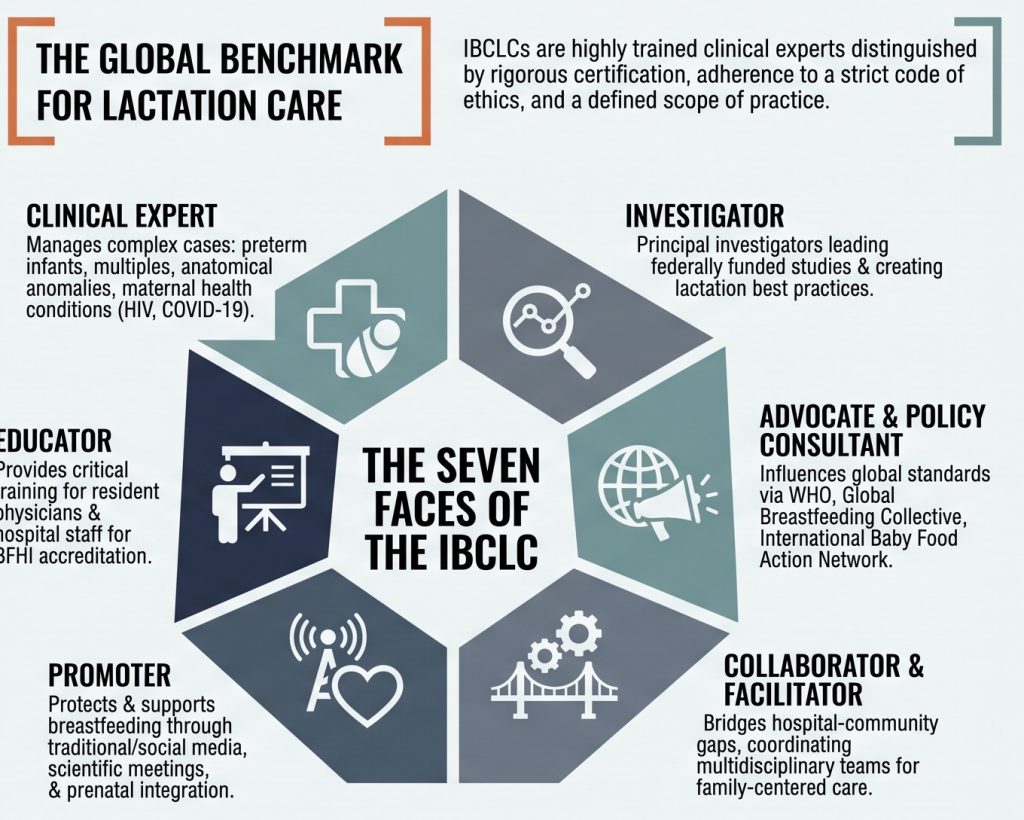
This April, the Journal of Human Lactation published the updated position paper on the role and impact of the IBCLC, the document the international lactation field will cite for years.
Its cost-effectiveness case cites the North Carolina Medicaid model. Work done by our neighbors, using our state’s data, is now the evidence base an international profession stands on.
The position paper’s broader synthesis of literature from 2011 to 2025 reaches the same conclusion from more directions: IBCLC support improves six-month breastfeeding rates and maternal self-efficacy; dedicated lactation consultants in neonatal intensive care units increase mothers’ own milk for the most fragile infants; and IBCLC availability tracks with state-level breastfeeding outcomes.
Milk is not a soft outcome for a NICU baby. It is infection prevention.
Why this matters right now
Medicaid covered 40.2% of U.S. births in 2024, and nearly half of births in rural communities. As coverage is squeezed and postpartum benefits come under review, lactation support is a predictable candidate for the cutting-room floor, it is small, it is preventive, and its savings show up in someone else’s budget line.
That is precisely the error. Cutting IBCLC access does not remove the cost. It moves the cost to lower respiratory tract infections, to gastroenteritis, to necrotizing enterocolitis. Those are the exact conditions the North Carolina model counted, and every one of them costs a Medicaid program far more than a lactation visit ever will.
You do not save money by defunding the intervention that prevents the expensive thing.
The ask
For state Medicaid programs: Cover IBCLC services as a reimbursable benefit. North Carolina’s own researchers built the model.
For legislators: Ask your fiscal staff to run the Wouk model against current numbers. The case gets stronger, not weaker.
Lactation support is not charity. It is one of the better returns in the maternal and child health budget and North Carolina already did the arithmetic.
Sources
- Ahmed AH, Rojjanasrirat W, Malik S, Mandell L, Ansell M, Zakarija-Grković I. The Role and Impact of the IBCLC: Updated Position Paper. Journal of Human Lactation. 2026 (OnlineFirst). doi:10.1177/08903344261434475
- Wouk K, Chetwynd E, Vitaglione T, Sullivan C. Improving Access to Medical Lactation Support and Counseling: Building the Case for Medicaid Reimbursement. Maternal and Child Health Journal. 2017;21(4):836–844. doi:10.1007/s10995-016-2175-x
- March of Dimes PeriStats. Medicaid coverage of births: United States, 2024. marchofdimes.org/peristats
- Georgetown University Center for Children and Families. Medicaid Plays a Key Role for Maternal and Infant Health in Rural Communities (2023 data). ccf.georgetown.edu