
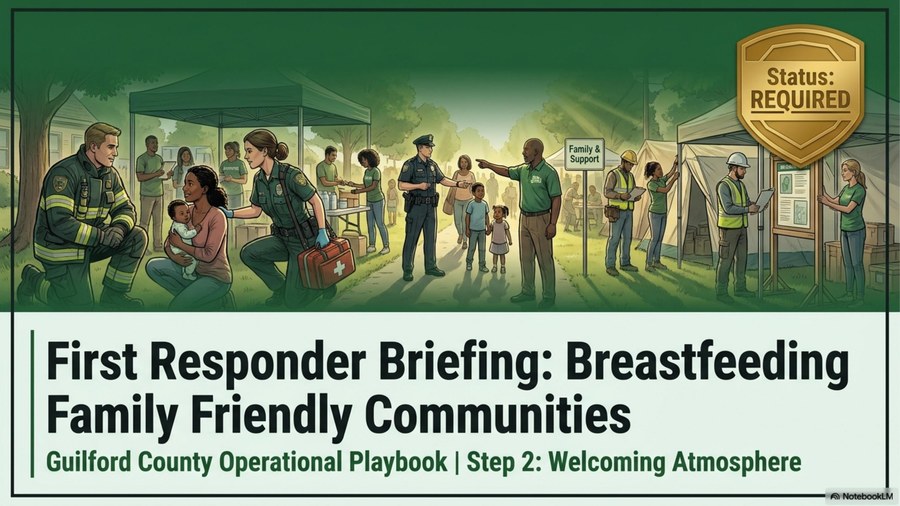
Step 2 of the Ten Steps. This training was first built with Breastfeed Guilford for police, fire, EMS and emergency management staff in Guilford County, North Carolina. Any community can use it as written or adapt it with BFFC. It covers state law, how to respond when someone complains about a breastfeeding parent, and what to do when a lactating parent or a formula-dependent infant needs your help in a micro-emergency or a large-scale disaster. It takes about eight minutes. When you finish, you can print a certificate of completion to share with your department.
About 95 percent
of infant deaths in emergencies are caused by contaminated water and unsanitary conditions
0 to 2 months
formula-dependent infants at this age are the most vulnerable in any emergency
Every day
first responders meet families with infants, and what happens in the first minutes matters
Why this matters. In Guilford County, where this training began, Black babies are far more likely to die in their first year of life than white babies, and that gap has not meaningfully changed in thirty years. The same pattern holds in many communities. First responders interact with families every day. The knowledge in this training can make a real difference.
Module 1 of 5: The law protects breastfeeding in public

This training uses North Carolina law. If you are outside North Carolina, check your state’s public breastfeeding statute; every state protects breastfeeding in public in some form.
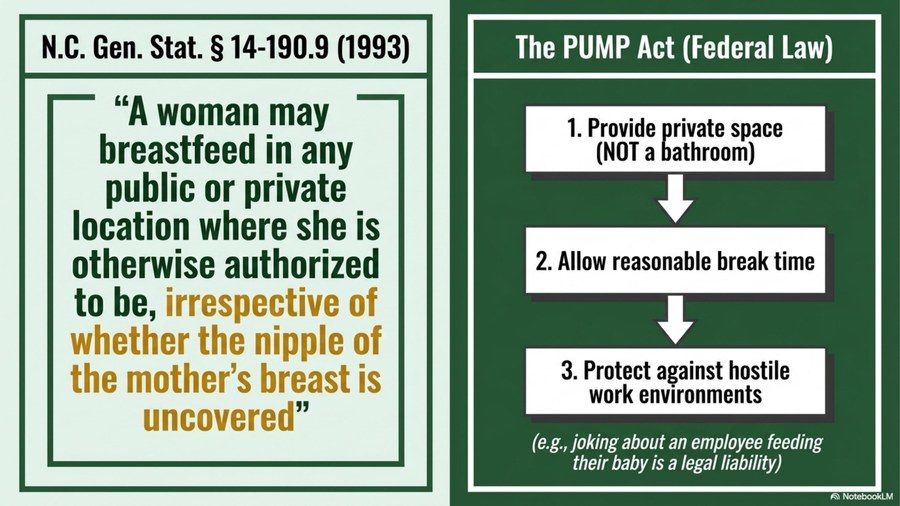
N.C. Gen. Stat. § 14-190.9 (1993), public breastfeeding. “A woman may breastfeed in any public or private location where she is otherwise authorized to be, irrespective of whether the nipple of the mother’s breast is uncovered during or incidental to the breastfeeding.”
A breastfeeding parent is not in violation of indecent exposure laws. There is no requirement to cover up, move, or stop. This applies in parks, restaurants, stores, libraries, government buildings, and every other public space.
The PUMP Act, federal law, effective April 2023. Employers, including cities and counties, must provide a private space that is not a bathroom and reasonable break time for any employee who needs to express milk, for up to one year after birth. This applies to owned and leased buildings. A supervisor joking that a colleague “has gone home to feed her baby again” can create a hostile work environment under the PUMP Act. That is a legal liability for the employer.
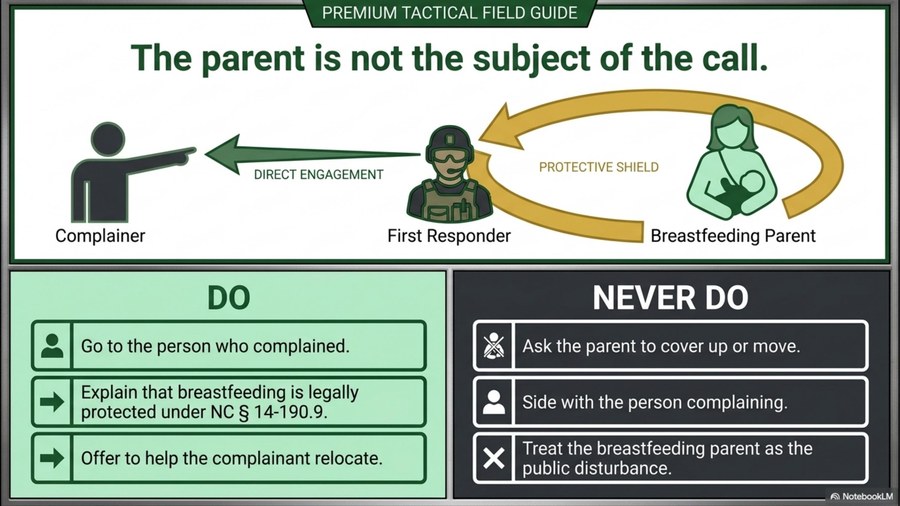
When someone complains, do this
- Go to the person who complained
- Explain that breastfeeding is legally protected under NC § 14-190.9
- Offer to help them relocate if they are uncomfortable
- Support the breastfeeding parent
Never do this
- Ask the parent to cover up or move
- Side with the person complaining
- Treat the breastfeeding parent as the problem
- Threaten citation or removal
Key principle: the parent exercising their legal right is not the subject of the call. The call is about someone who is uncomfortable. Those are two different people. Respond accordingly.
Module 2 of 5: Micro-emergencies
A car accident, a domestic call, a welfare check, a mental health crisis: any of these can involve a lactating parent and an infant. What you do in the first minutes has real consequences for both of them.
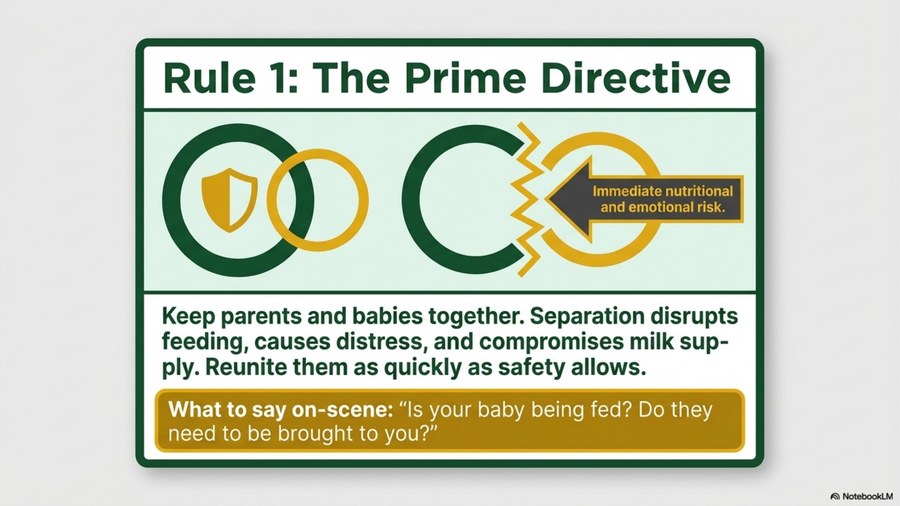
Rule 1: keep parents and babies together. Separation disrupts feeding, causes distress to both parent and infant, and can compromise milk supply. An infant who cannot be fed by their parent is at immediate nutritional and emotional risk. Reunite them as quickly as safety allows. Ask: “Is your baby being fed? Do they need to be brought to you?”
Rule 2: formula-dependent infants ages 0 to 2 months are the most vulnerable. Formula requires clean water, a clean container, and a heat source. Any formula or pasteurized milk left out must be discarded after 2 hours; it grows bacteria and yeast and becomes dangerous. Breastmilk is safe at room temperature for up to 6 hours. Nutrition directly from the breast is always the safest option.
Rule 3: stress inhibits letdown, not milk supply. A stressed parent can still make milk. Stress affects their ability to release it. A calm, private space helps letdown occur. Infants sense parental stress and will nurse more, cry more, and be fussier. That is a stress response, not a feeding problem. A blanket in the back of a patrol car can be enough.
Scenarios
A. Parent separated from infant at a scene. A lactating parent is at a scene and their infant is with another person or in the vehicle. The infant is unharmed. Reunite parent and infant as quickly as safety allows. Ask: “Is your baby being fed? Do they need to be brought to you?”
B. Parent in distress, infant unfed. The parent is upset or in shock and says she cannot breastfeed right now because she is too stressed and her milk won’t come. Reassure her: “Stress affects how easily milk flows, not whether you have it. Let’s find somewhere quieter.” Create a private, calm space. Even a blanket in the back of a patrol car works.
C. Formula-dependent infant, no clean water or supplies. The family has powdered formula but no access to clean water, or the formula has been out in an open container for over 2 hours. Discard the open formula. Contact WIC or an infant feeding specialist. If the parent can breastfeed at all, even partially, encourage it. If formula is unavoidable, ready-to-feed sterile 59 ml (2 fl oz) bottles are the only safe option: already sterile, no water or preparation needed.
D. Family needs to clean infant feeding supplies. Only a high-occupancy public restroom is available, which is not safe for washing baby feeding equipment. Direct them to a clean sink that is not a public restroom. Ideal supplies: plain unscented bleach (no thickener or fragrance), dish soap, a bottle brush, a washbasin, and a way to air dry. If no clean sink is available, single-use disposable cups are safer; use a clean one each time rather than rewashing in potentially contaminated water.
Module 3 of 5: Large-scale emergencies
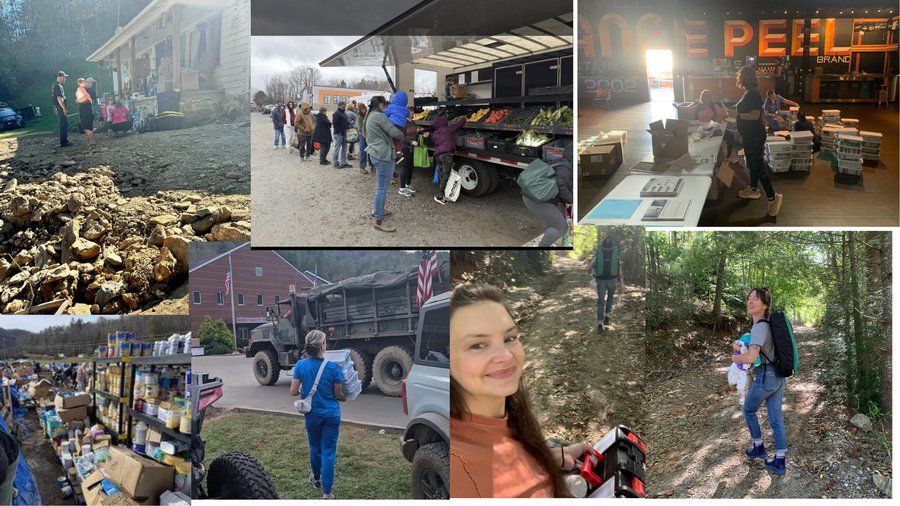
Build the relationship before the emergency. When Hurricane Helene struck Western North Carolina on September 27, 2024, Asheville’s breastfeeding coalition had been building relationships with first responders since 2019. When everything was covered in mud and sewage, those relationships made all the difference. In all, 376 volunteers answered the call. More than 1,400 families were served, more than 250,000 ounces of human milk moved, equivalent to about 83,000 infant meals, and more than 7,000 infant feeding sanitation kits went out. The response is documented at safeinfantfeeding.org.
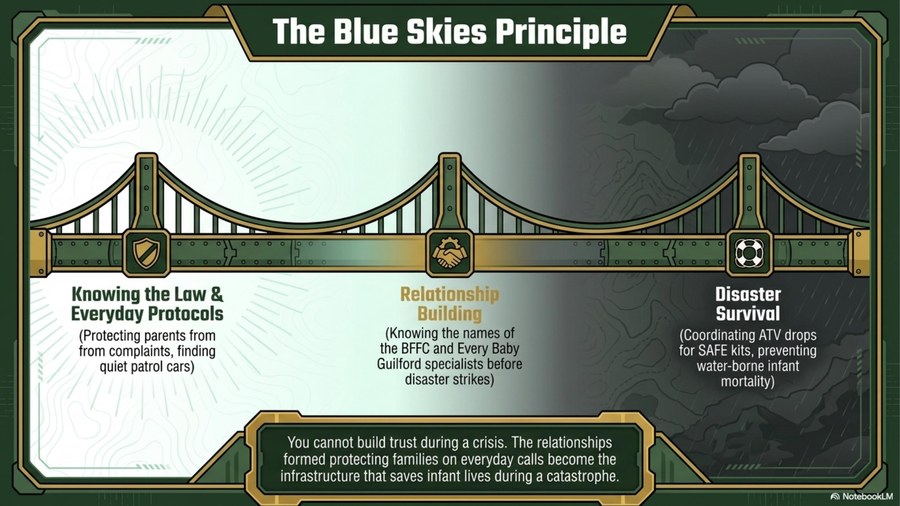
“The infant feeding specialists walked trails, stood in line at food distribution centers, checked formula expiration dates, and conducted rapid needs assessments on families. The first responders carried the kits, on ATVs, by helicopter, lifted by fire wires, getting supplies to families where roads no longer existed. They kept us safe. We knew each other’s names and phone numbers before any of that happened. We had had the conversation during blue-skies time.”
Love Anderson, President and CEO, Breastfeeding Family Friendly Communities
Infant feeding safety in any emergency, safest to least safe
Help families move as high up this list as conditions allow.
- Direct breastfeeding or chestfeeding. Always safest. No supplies needed. Temperature-regulated. Provides antibodies. If expressed, safe at room temperature for up to 6 hours.
- Expressed human milk from the parent. Safe if stored correctly. Without refrigeration, use within 6 hours. Assess carefully with spotty power.
- Pasteurized donor milk, labeled, still frozen. Safe if from a milk bank or known community source. Do not use if thawed and refrozen.
- Ready-to-feed sterile formula, 59 ml (2 fl oz) bottles with a sterile nipple. The only safe formula option in emergencies. Already sterile. No water, no mixing, no preparation. Use when formula cannot be avoided.
- Powdered formula, only with verified clean water. Not sterile. Requires clean water, a clean container, and preparation. High contamination risk. Last resort. Discard if out 2 hours or more.
- Avoid: homemade formula, concentrated formula without clean water, and unsolicited donations of unknown origin or storage history. Discard formula in open, damaged, or flood-exposed containers.
Module 4 of 5: Knowledge check
Select the best answer for each scenario. You will see immediate feedback and the correct answer if you miss one.
Module 5 of 5: Your commitments and certificate
Check each commitment, then enter your name to generate your certificate.
Certificate of Completion
Breastfeeding Friendly First Responder
Has completed the Breastfeeding Family Friendly Communities First Responder Training covering public breastfeeding law, the PUMP Act, micro-emergency protocols, and infant feeding safety in large-scale emergencies.
Issued by Breastfeeding Family Friendly Communities · breastfeedingcommunities.org
Want this training adapted for your county, with your own laws, contacts and local examples? See how we work with communities. For the full emergency-response picture, visit the SAFE Infant Feeding Team.