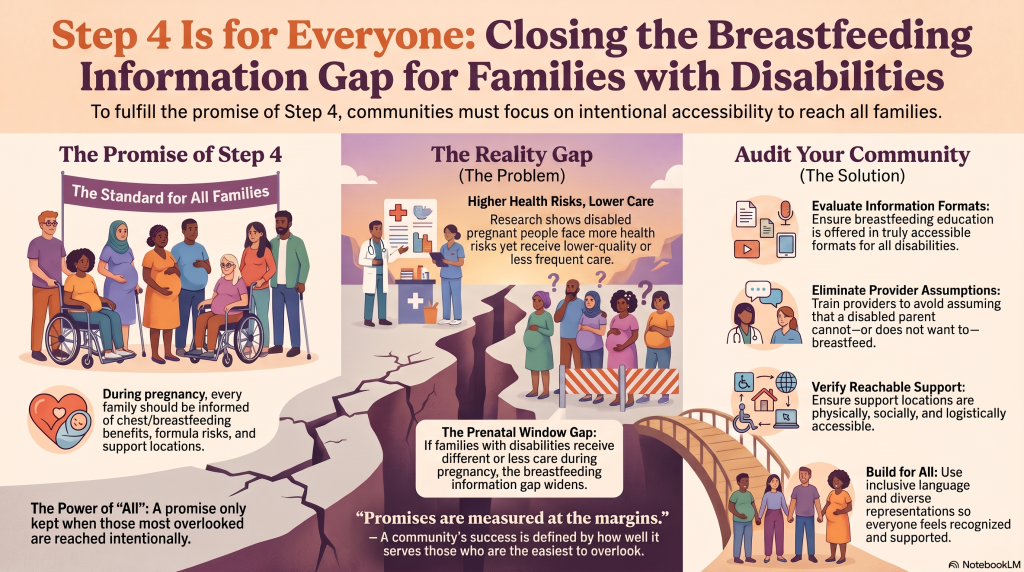
Step 4 of the Ten Steps to a Breastfeeding Family Friendly Community is deceptively simple: during pregnancy, all families in the community are informed about the benefits of chest/breastfeeding, the risks of unnecessary formula use, and where to find support.
The word I keep coming back to is all.
New research from the Lurie Institute for Disability Policy at Brandeis University gave me a reason to sit with that word longer. In a short research-summary video, How Disability Impacts Pregnancy Health Risks and Care, their team lays out a hard finding: disabled pregnant people enter pregnancy with higher rates of health risks and they don’t receive the same care that non-disabled pregnant people get. Two peer-reviewed studies sit underneath it: one on pre-pregnancy health risks by the presence and extent of disability, and one on the receipt and content of care across the pre-pregnancy, prenatal, and postpartum stages.
Read those two findings together and a pattern appears. If families with disabilities are already starting pregnancy at higher risk, and then receiving less, or different, care along the way, then the prenatal window is exactly where a gap either widens or begins to close. And prenatal information about breastfeeding is precisely what Step 4 is about.
So I want to ask our communities a direct question: are families with disabilities in your community actually getting breastfeeding information during pregnancy? Not just “is it technically available,” but: is it offered in accessible formats? Is it coming from providers who don’t make assumptions about whether a disabled parent wants to, or can, breastfeed? Is “where to find support” a real, reachable answer for them?
Step 4 doesn’t say most families, or the families who are easiest to reach. It says all families. That’s a promise, and promises are measured at the margins, by whether the people a system tends to overlook are the ones it reaches on purpose.
Watch the Lurie Institute’s research video, and then take a look at your own Step 4 practices with disability in mind. If we mean all, our prenatal education has to be built for all.
(A language note, echoing the researchers’ own: not everyone who gives birth identifies as a woman. The studies use “women” consistent with their source data; we use inclusive language and recognize the range of people this work is for.)